

Featured comment

“Awesome recipe! Turned out perfect. Pic here, a slice toasted with avocado, red onions and beetroot, carrot and cumin sauerkraut. Divine! Thanks for the recipe, it is a winner (and I am not even gluten free!) 🙂”
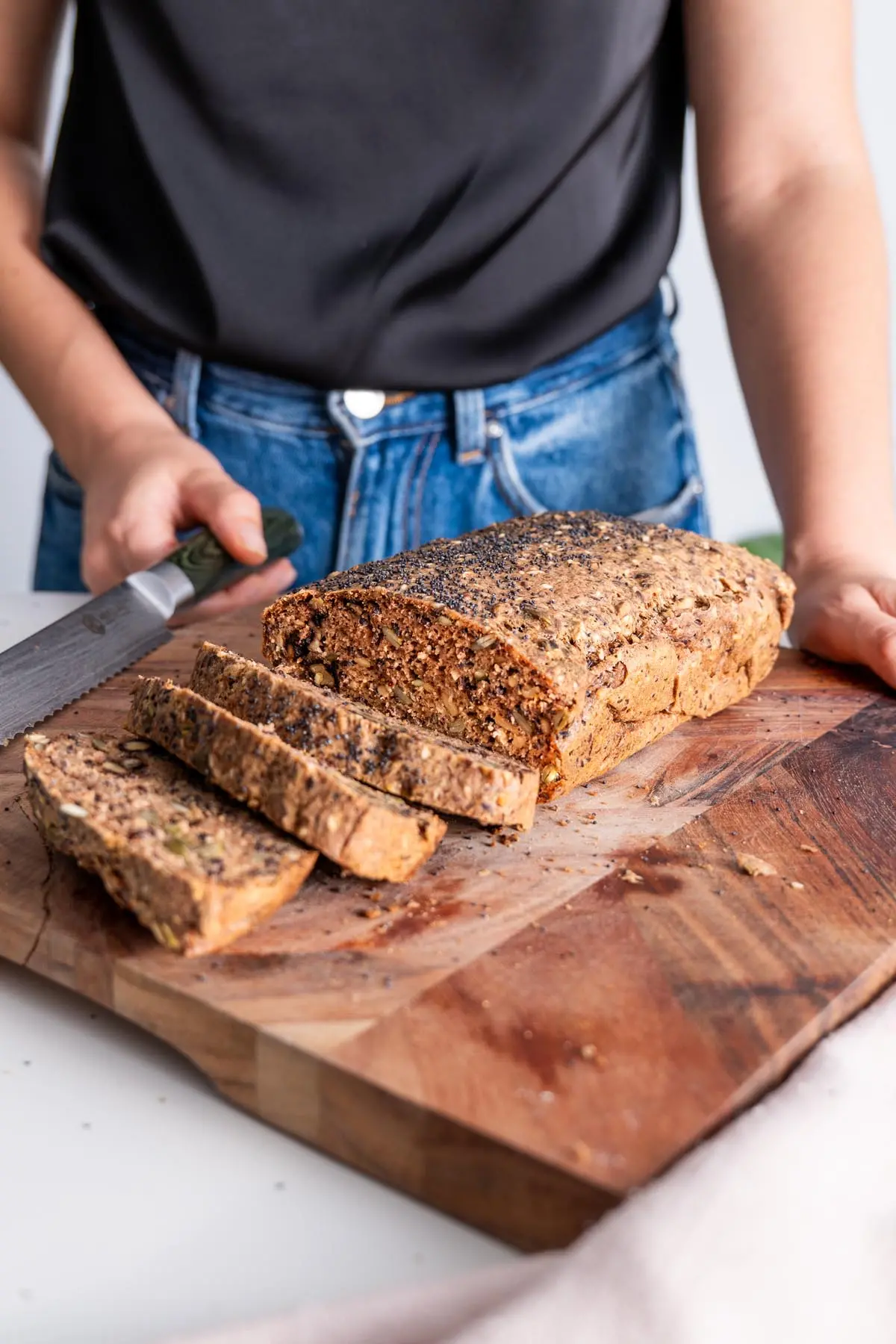
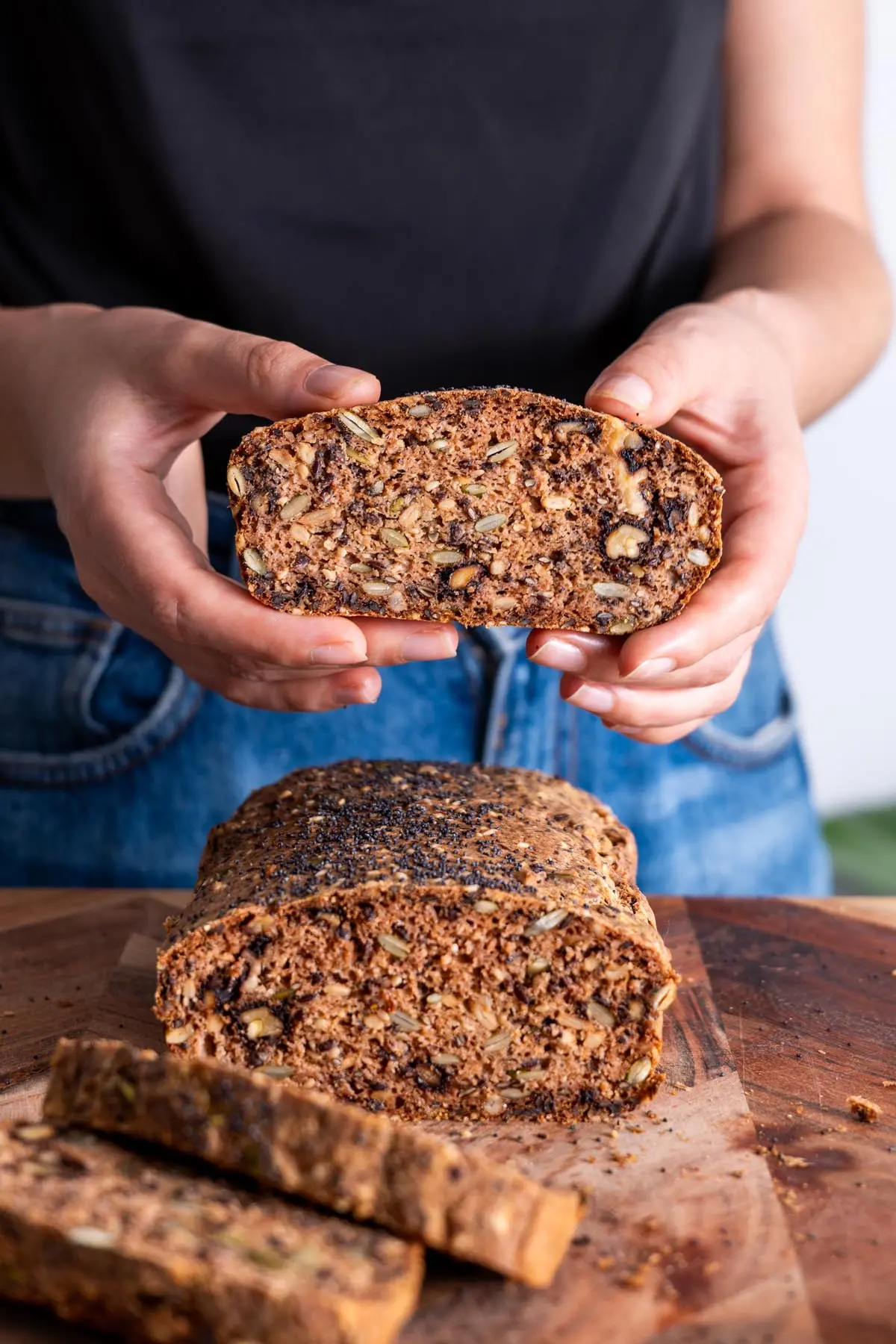
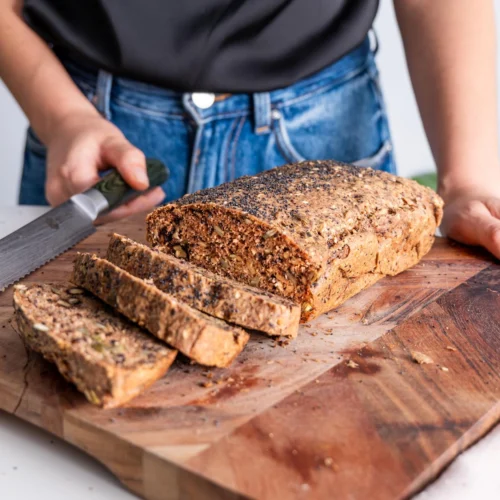
This gluten-free seeded bread is incredibly easy to make, super nourishing, and has the best chewy, nutty texture. Packed with fiber, healthy fats, and whole seeds, it’s perfect toasted with a spread or as a base for savory toppings. It also holds together beautifully, which isn’t always the case with gluten-free breads.
It’s a great option for anyone looking for a more nourishing homemade bread recipe or to work on your gut health in a super easy way. Studies show that eating a wide variety of plants is a great way to support gut health by keeping your gut microbes happy. One commonly recommended goal is to include at least 30 different plants per week in your diet. This bread includes 9 unique plants in one recipe, making it a delicious and simple way to reach that goal!
It took me over 10 trials to perfect this recipe, and I could not be happier with the results. We’ve been having it on repeat for avocado toasts, but my favorite way to enjoy it is toasted with some tofu cream cheese and blueberry jam. The nutty taste pairs so beautifully with the creamy texture and berry spread! If you love this one, my 1-ingredient buckwheat bread, red lentil quinoa bread, and seeded crackers are next on your bake list.
Why I love this recipe (as a nutritionist)
- Gluten-free: perfect if you have to avoid gluten
- Packed with nuts and seeds: rich in minerals, and linked to reduced risk of chronic disease. Consuming a 28g daily serving is linked to a 20% lower risk of early death.
- Gut health friendly: with 9 to 11 unique plants (depending on whether you’re using seasonings or not), including psyllium husk (a great prebiotic), each slice is a feast for our microbiome
- High in fiber: thanks to flax, seeds, and whole grains
- Good source of healthy fats: from walnuts, seeds, and olive oil
- Meal prep friendly: stays fresh for days and freezes well
- No fancy equipment: no blender or processor needed, just a bowl, spatula, and loaf pan
- No rise time: just mix and bake, so easy!
Ingredient notes
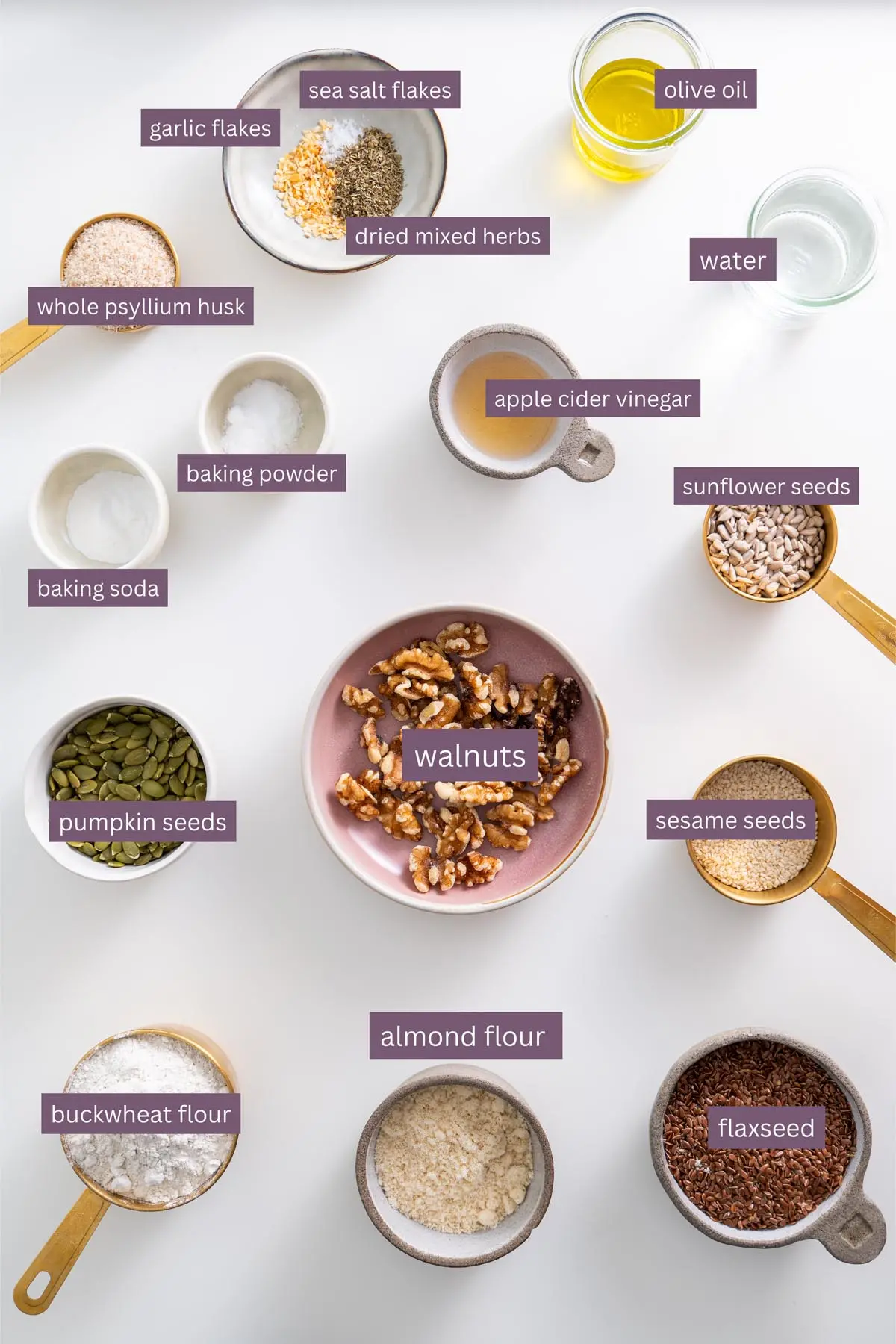
- Walnuts, flaxseeds, sunflower seeds, sesame seeds and pumpkin seeds: add minerals crunch and healthy fats
- Buckwheat flour: naturally gluten-free and great for density
- Psyllium husk: essential for the chewy texture and binding. It acts as a gluten replacement.
- Apple cider vinegar and baking soda: react to help the loaf rise
How to make this recipe (summary)
Start by preheating the oven to 350°F (180°C) fan. In a large bowl, add all dry ingredients, then pour in the vinegar, oil, and water.
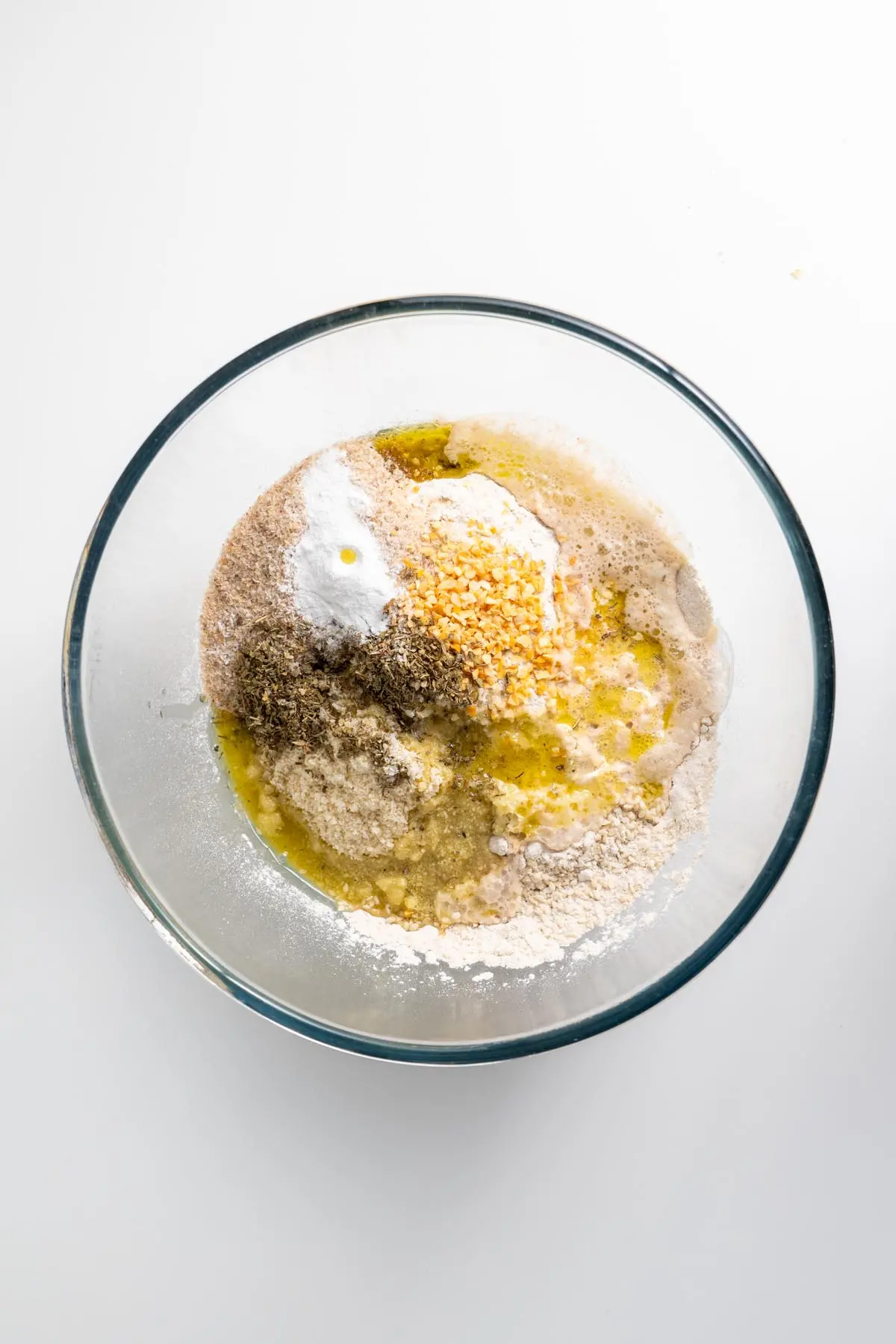
Mix everything together until fully combined into a thick batter.
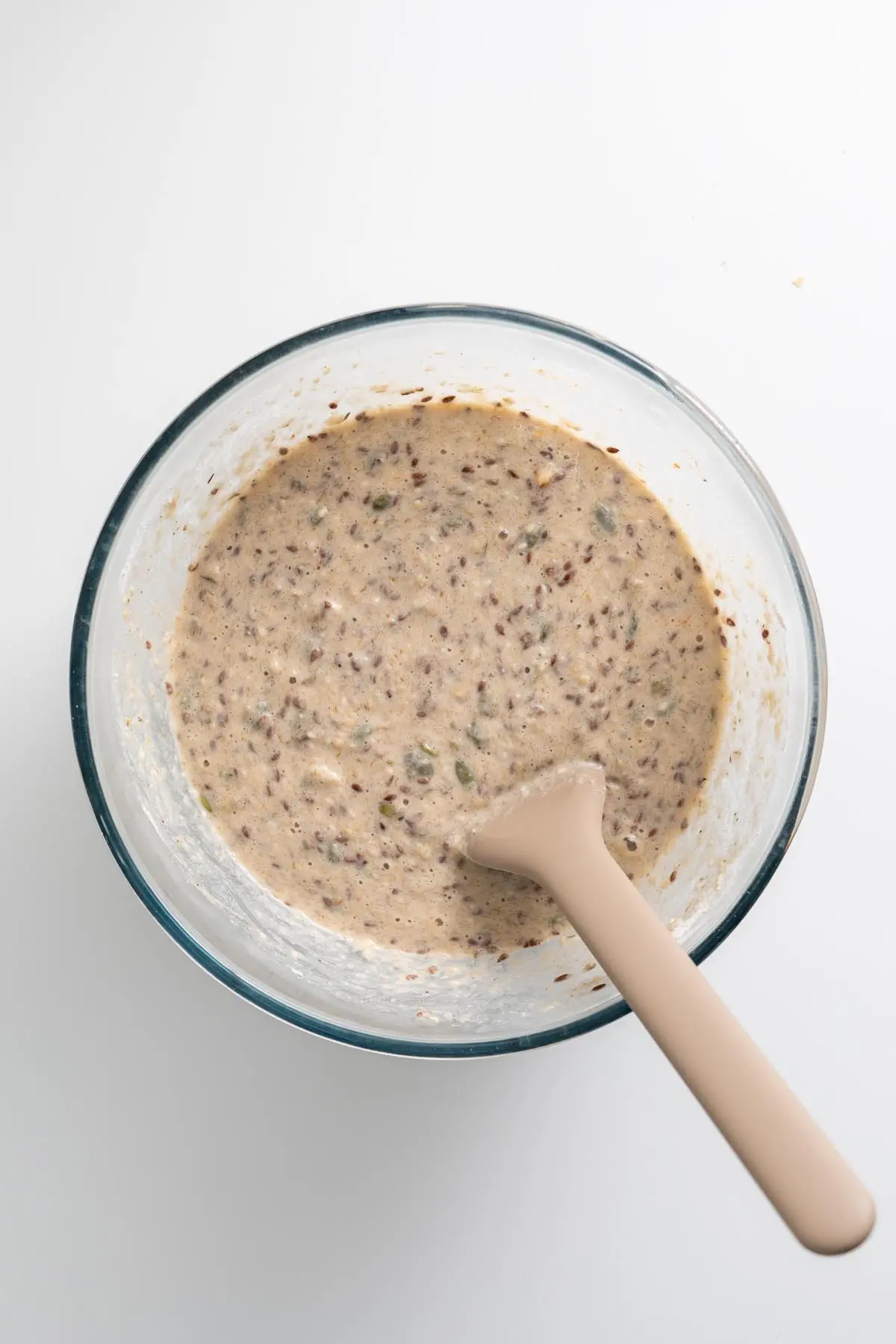
Rest the batter in the pan for 10 minutes to allow the psyllium to activate.
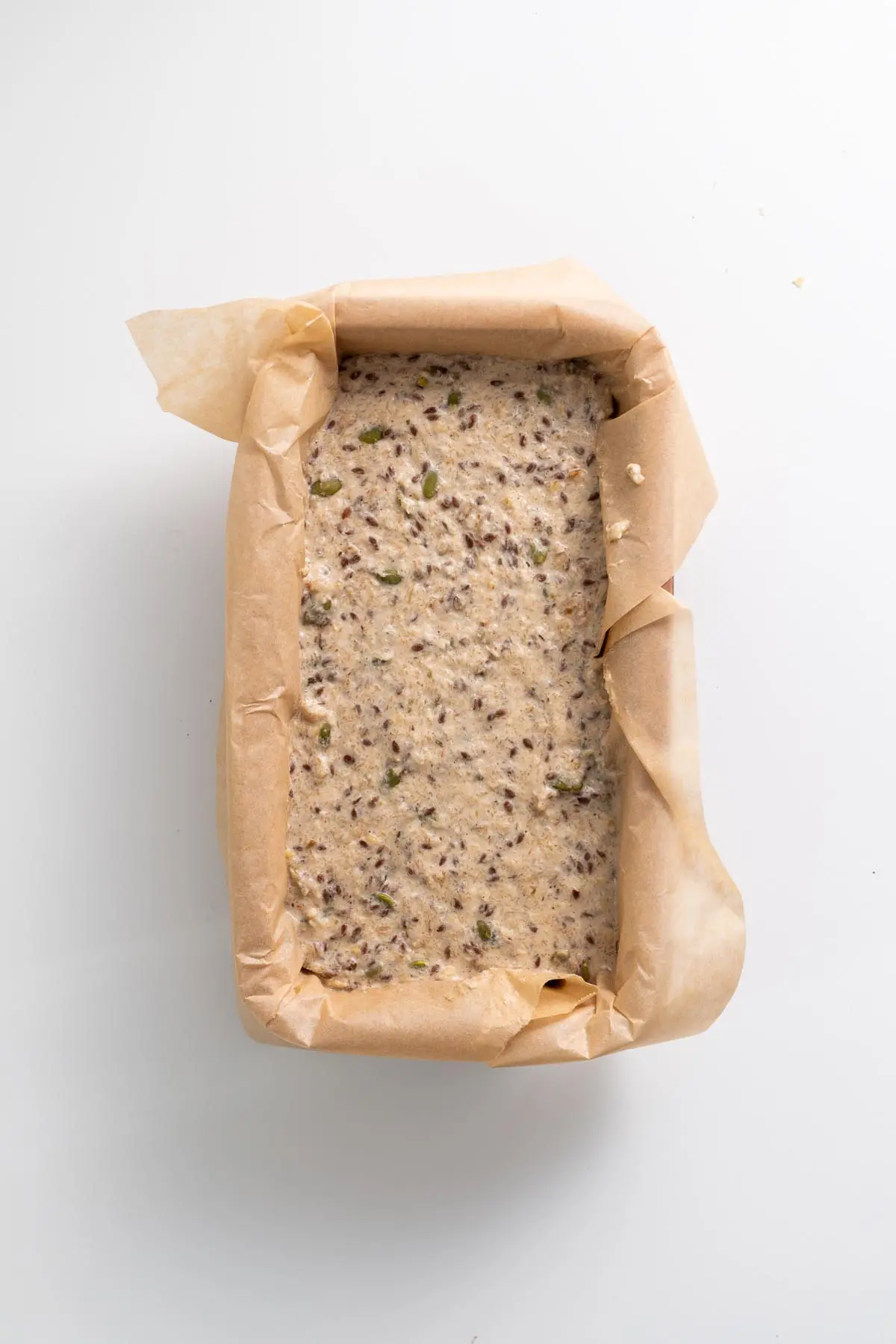
Bake on the middle rack for 90 minutes until the crust is firm and deep golden brown.
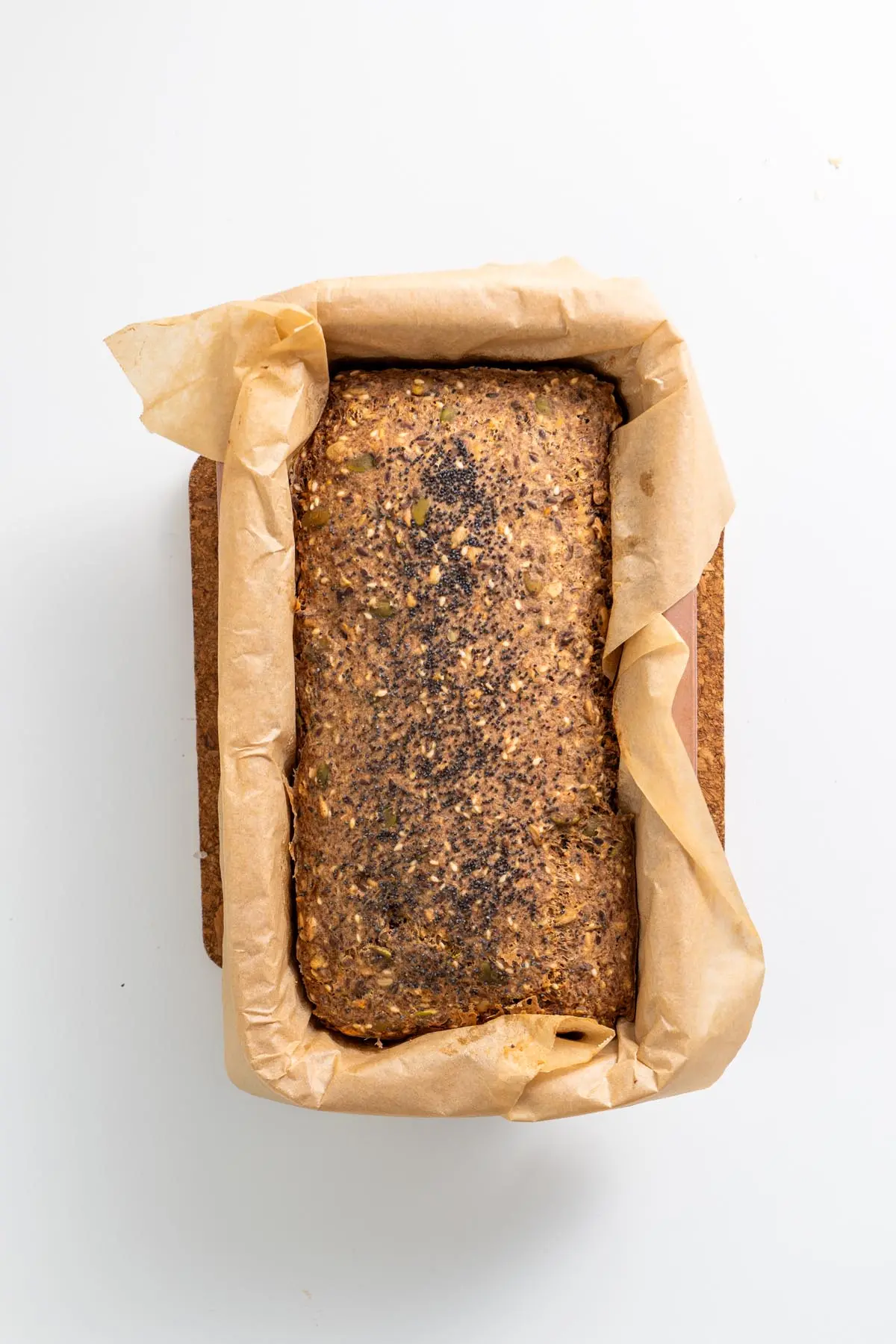
Cool the bread on a wire rack to prevent it from steaming and softening underneath.
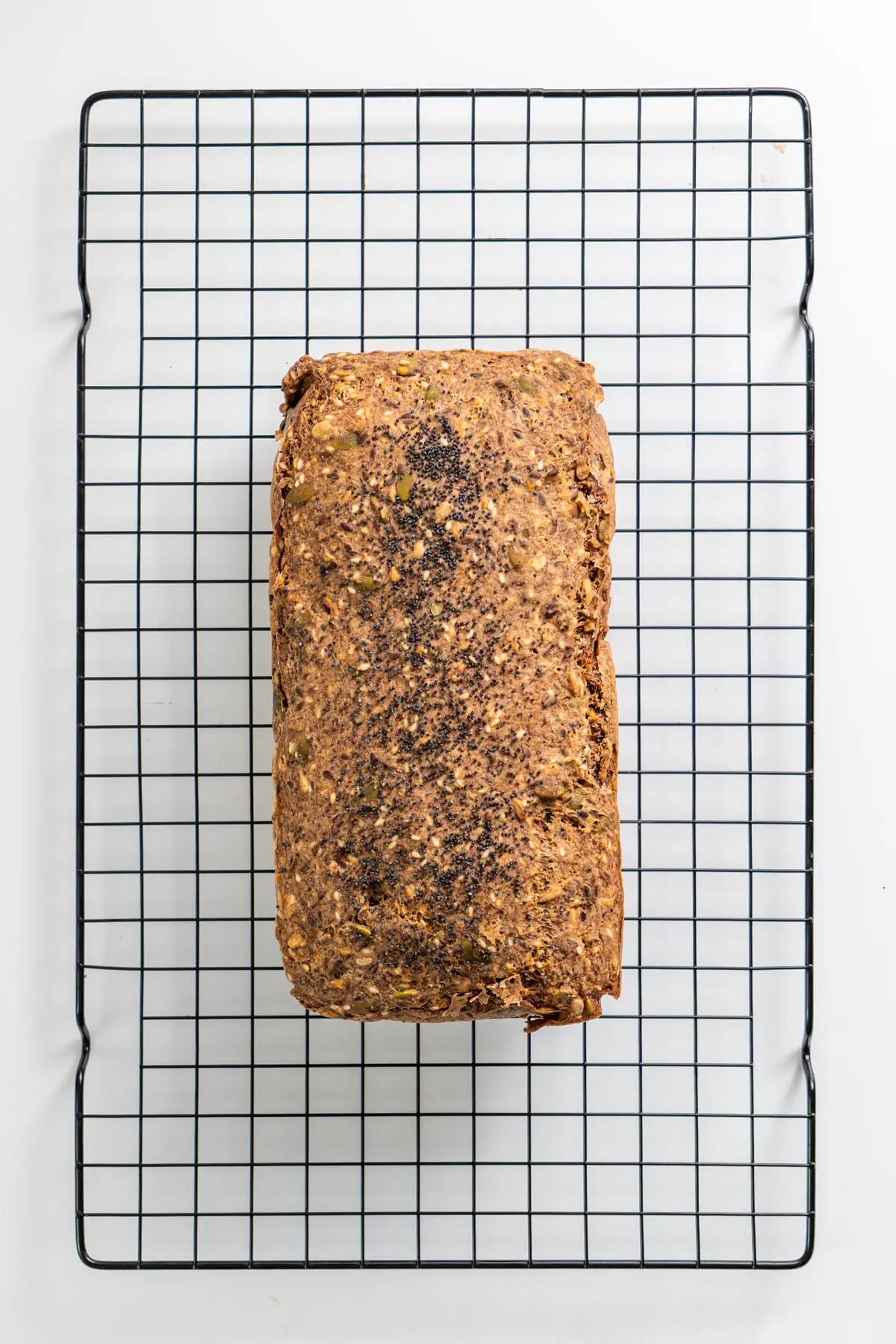
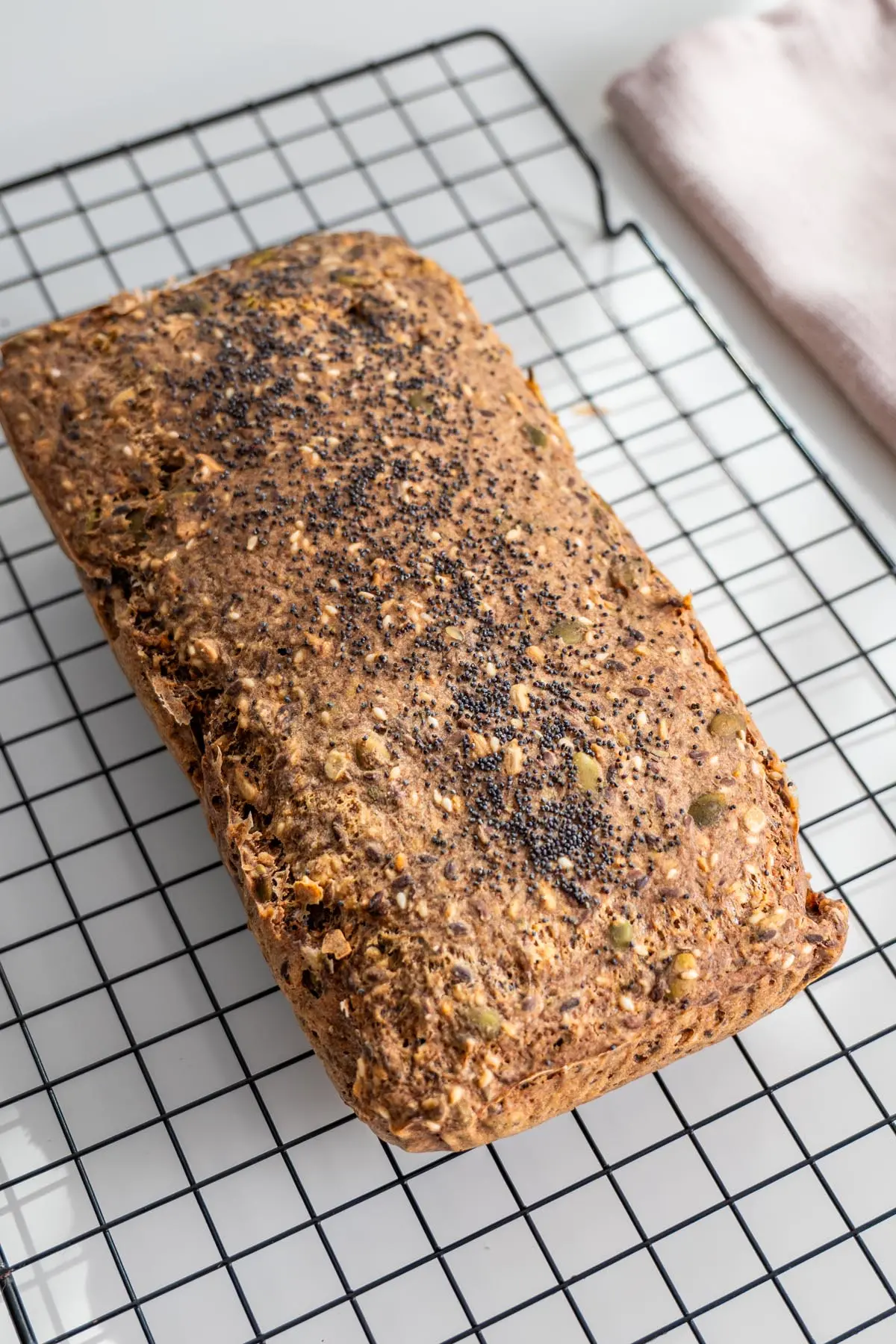
Slice once completely cool. The crumb holds together beautifully!
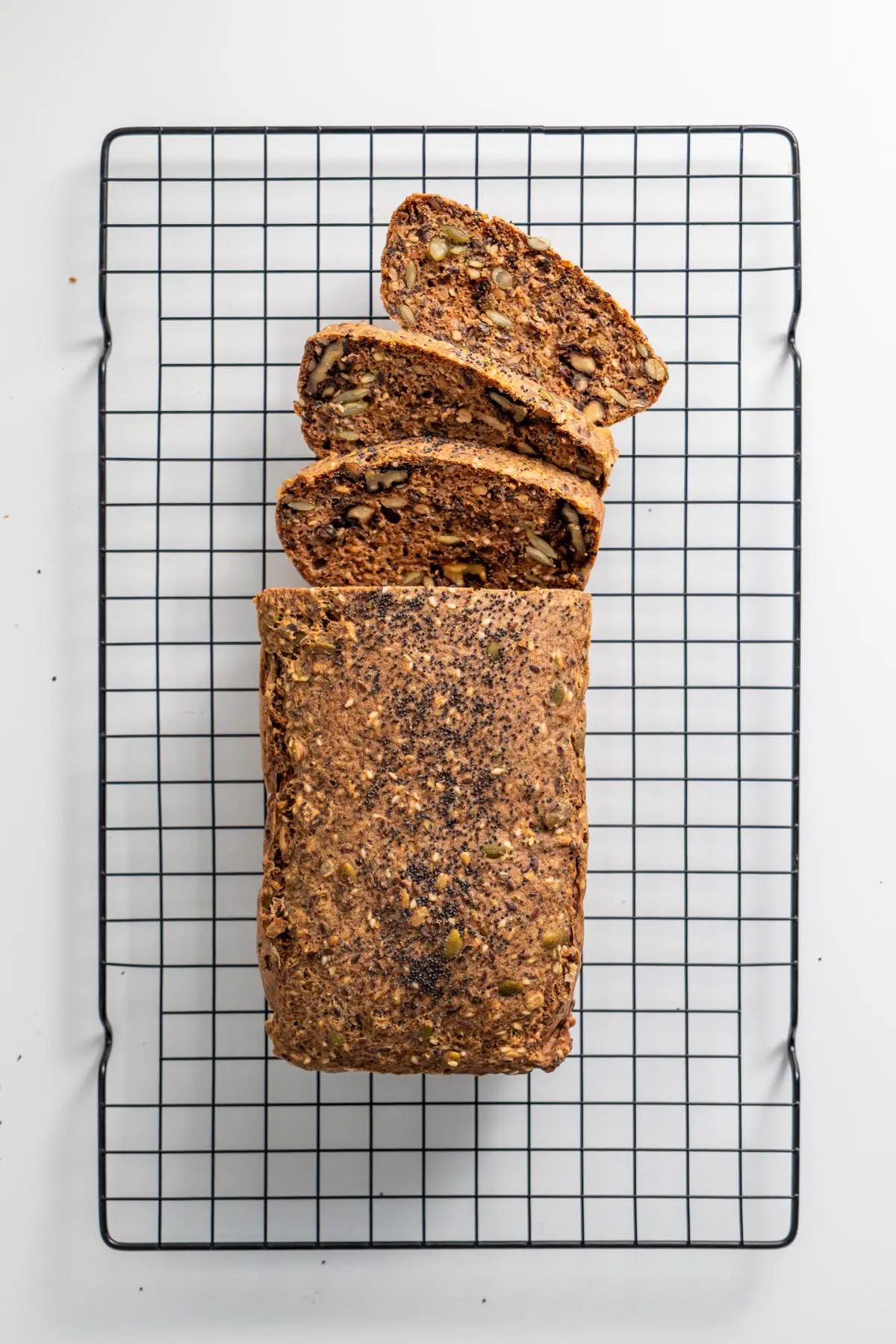
View recipe card below for detailed instructions.
Variations and tips
- Do not use chia seeds: including them gave the bread a more spongy texture
- Mix the seeds: I have tried different combinations, and the one provided here is my favorite. However, you can play around with the amounts slightly. Just make sure you end up with the same amount of seeds at the end to obtain similar results
- Add flavor: try caraway, fennel, chili, onion flakes or cumin seeds for extra aroma
- Make it sweet: add a dash of maple syrup or coconut sugar, skip the garlic flakes, however a little thyme or rosemary can be lovely when paired with sweet toppings.
- Toast it: The nutty flavor is next level when toasted. I like to put mine in the air fryer for a few minutes.
- Storage: Keep it in the pantry for 2 days. Keep it in the fridge for 5 days; however, it loses a little of its texture after being in the fridge, and I prefer to have it toasted in that case. Slice and freeze for up to 2 months. It’s great reheated in the air fryer or oven.
- Don’t skip the psyllium: it’s key for texture and structure


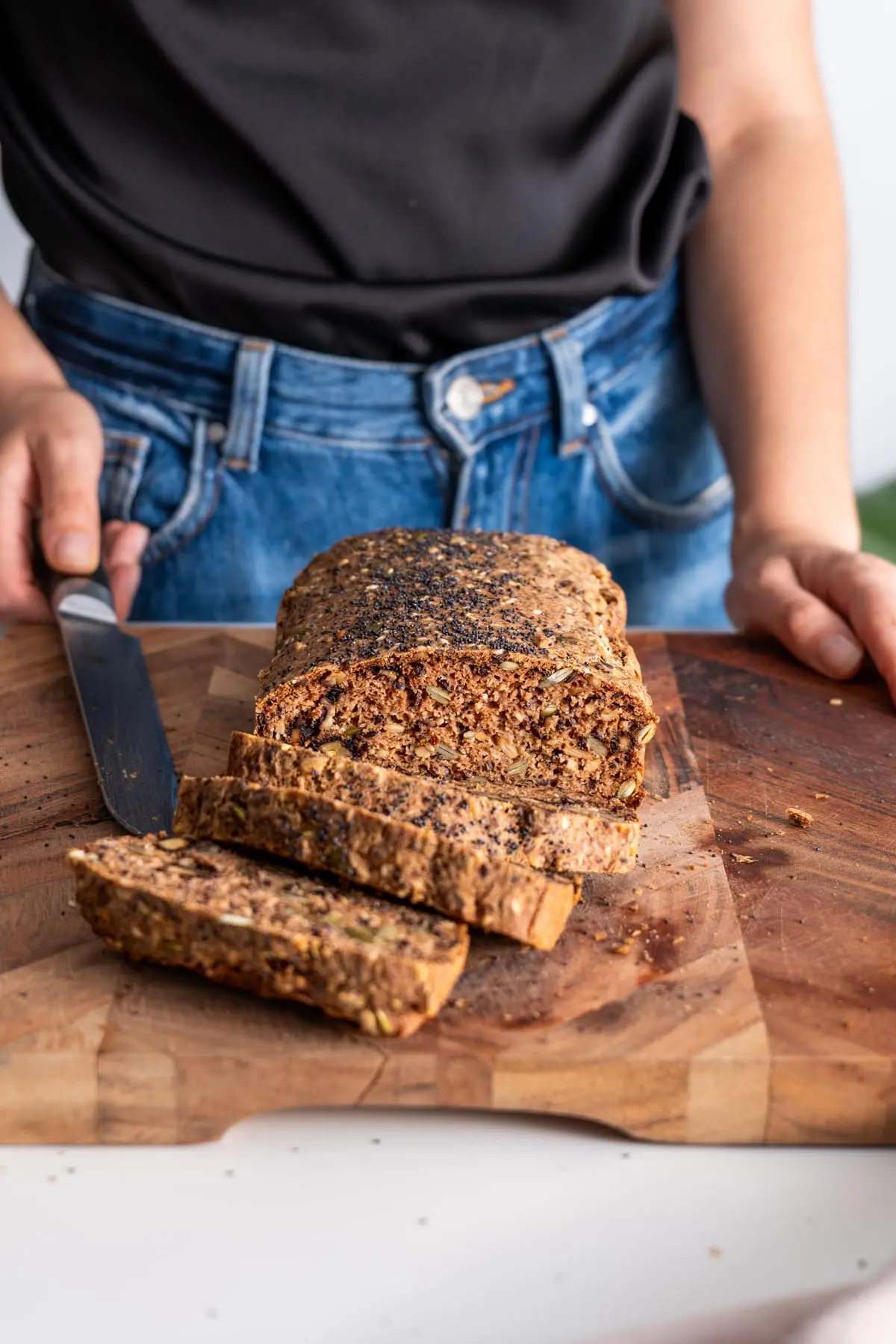
Why you’ll love this gluten-free seeded bread TLDR
- Fiber-rich
- Gut health friendly
- Super satisfying
- Meal prep friendly
- Gluten-free
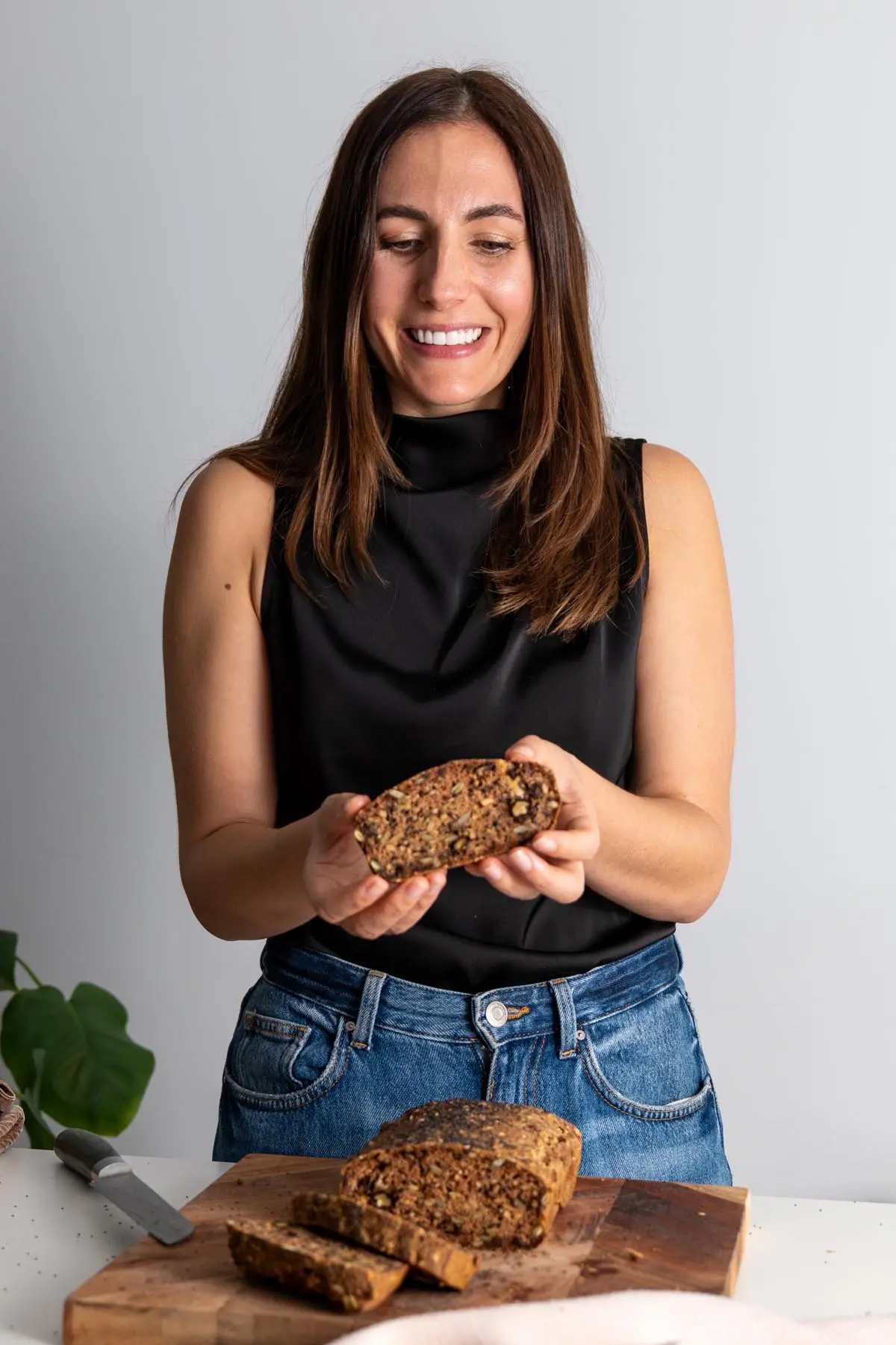
FAQ
Is this bread gluten-free?
How do I store this bread?
What can I use instead of psyllium husk?
Can I substitute the almond flour?
Can I make this oil-free?
Do I need to grind the flax seeds, or can I use flax meal?
Can I substitute the buckwheat flour?
Can I make almond flour at home from whole almonds?
What if my oven doesn’t have a fan setting?
Why is my mixture so runny?
Gluten-Free Seeded Bread
Equipment
Ingredients
- ½ cup (85 g) flaxseed
- ½ cup (60 g) pumpkin seeds
- ½ cup (50 g) walnuts - roughly chopped
- ¼ cup (35 g) sunflower seeds
- 2 tbsp (18 g) sesame seeds
- 1 cup (120 g) buckwheat flour
- ¼ cup (20 g) whole psyllium husk
- ½ cup (56 g) almond flour
- 1 ½ tsp (6 g) baking powder
- 1 ½ tsp (6 g) baking soda
- 1 tbsp (15 ml) apple cider vinegar
- 1 ½ tsp (9 g) sea salt flakes
- 1 tbsp (10 g) garlic flakes - optional
- 1 tsp (1 g) dried mixed herbs - optional
- 3 tbsp (45 ml) olive oil
- 2 ¼ cups (535 ml) water
Instructions
- Preheat the oven to 350°F (180°C), fan on.
- In a large mixing bowl, add the flaxseed, pumpkin seeds, walnuts, sunflower seeds, sesame seeds, buckwheat flour, psyllium husk, almond flour, sea salt flakes, garlic flakes, mixed herbs (if using), baking powder, and baking soda. Pour the apple cider vinegar over the baking soda to activate it, you’ll notice it begins to bubble. Then add the olive oil and water, and stir well until all combined.

- Line a loaf pan (9.5x5x2.5in) (24x13x6.5cm) with baking paper. Pour in the mixture and let it sit for 10 minutes. Optionally, sprinkle extra seeds on top for decoration.
- Place the pan horizontally on the middle rack of the oven and bake for 90 minutes.
- Once baked, remove the loaf from the pan and baking paper immediately, and place it on a cooling rack to prevent moisture from softening the crust (see notes). Allow it to cool completely before slicing, I made 20 slices.
Notes
- Mixed herbs: Use any herbs you’d like, rosemary, thyme, oregano, basil.
- Cooling tray: If you do not have a cooling tray, use a wire rack from your oven or grill toaster.
- Cooling time: When bread or cake cools, the texture sets and the steam escapes, helping it firm up. This also allows moisture to redistribute evenly, so the crumb isn’t gummy in the middle or dry at the edges.
- Oven temperatures: This recipe was tested in a convection (fan-forced) oven, which circulates hot air so it bakes faster and more evenly. If you’re using a conventional (non-fan) oven, you can try increasing the temperature by about 35°F (20°C), baking on the middle rack, and rotating the pan halfway through. Every oven behaves a little differently, so results may vary. Start checking a few minutes before the suggested time and trust your eye: it may need a little longer to become golden and cooked through.
Video
Per Serving/Portion
You might also like


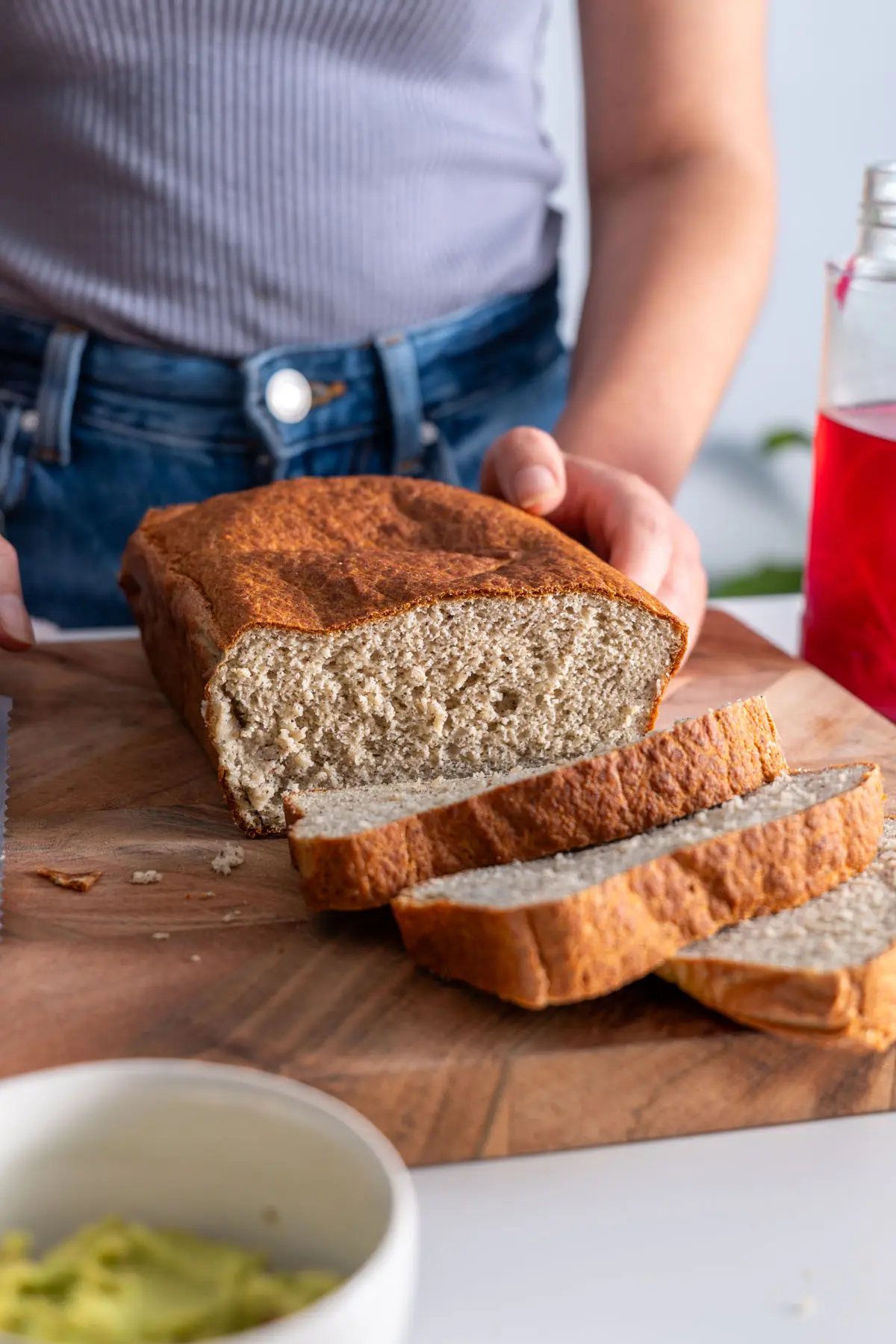
Straight from your kitchens.
Snap a photo in the comments on any recipe. We love to see it! Here’s what the community has been cooking recently.


Just leave a comment on any recipe and attach a photo


Awesome recipe! Turned out perfect. Pic here, a slice toasted with avocado, red onions and beetroot, carrot and cumin sauerkraut. Divine! Thanks for the recipe, it is a winner (and I am not even gluten free!) 🙂
That looks amazing Dayna! Thank you so much for sharing, I’m so happy you’re loving the bread 😍
I left my comment here yesterday, but never received a response nor I can see it here?
Hi Aneta, it’s just me responding to the comments, and sometimes I take a little day off 🙏 Hope you understand and have a great day, Sarah
Hi, I would like to make this bread, but could olive oil be changed for any other oil? Thanks
I think any liquid oil (not coconut) would work, let us know how you go 🙂
Thanks for your quick reply! It worked great! The loaf is fantastic. I gave it to a celiac person to try, and she was impressed with the nice texture! Love your recipes!
That’s amazing, so happy you and your friend liked it! Your loaf looks beautiful, thank you for sharing Rita 💚
Do you think this could be made without any oil or some other non-fat liquid substitute? TIA
I have not tested it, but I think it will affect the texture. Let us know if you experiment with the recipe 🙂 Alternatively you might prefer one of these recipes instead ⬇️
https://plantbaes.com/1-ingredient-gluten-free-buckwheat-bread/
https://plantbaes.com/red-lentil-quinoa-bread-gluten-free/
Thank you.
Hi, looking forward to making this recipe, can I substitute more buckwheat flour or oat flour for the almond flour? Love your site! Thanks.
Hi Claudia, thank you for the kind words 💚 I have only tested the recipe as written. Almond flour helps give it a soft texture. Let us know if you experiment with the recipe 🙂
If you’re looking for almond-free bread recipes you might like one of these:
– https://plantbaes.com/1-ingredient-gluten-free-buckwheat-bread/
– https://plantbaes.com/red-lentil-quinoa-bread-gluten-free/
Hi thanks for reply, I will try without the almond flour and let you know how it goes. I’ll look up your other recipes. Thank you.
Can’t wait to hear how you go 💚
I think there’s too much water in the recipe, my mixture came out so runny and it doesn’t look like you’re pouring 2 and 1/4 cup of water in the video, looks less….It’s in the oven now, so will see what happens 🤞🏼🤞🏼🤞🏼
Hi Aneta, 2 1/4 cups of water is correct, the mixture is indeed runny, and it firms up in the oven. Hope you love the bread 🙂
I absolutely hate to be “that person” but do you have any recommendations on what could work as a substitution for the pumpkin seeds? Perhaps something like thin sliced almonds? I am allergic but this looks fantastic.
HI S, no worries at all, that’s what I’m here for, always happy to give a substitution recommendation 🙂 sliced almonds sound delicious, or you can add more sunflower seeds or walnuts. Hope you love it, and let us know how you go 🙂
The bread is great!
I can’t eat almond flour, so I have put chickpeas flour, and it worked out just fineg (even though I know it is not a good substitute). However, I don’t know why, but around all the walnuts inside bread, I have gotten like black layer around it, and I don’t know why. The taste is still ok, but looks a bit funny. Do you know why this happened?
Hi Maria, thank you so much for sharing, it’s wonderful to know that it worked with chickpea flour! The texture looks great, I’ll have to try it for myself 😍
About the discoloration around the walnut, it’s totally harmless, it’s a natural reaction. The polyphenols in walnuts react with oxygen and the pH of the dough, and when exposed to moisture and heat, they turn brown or sometimes slightly purple. This can be stronger if your dough is more alkaline, for example, if it contains baking soda like in our bread (which is not the case in sourdough for example). I genuinely don’t mind the color change, but if you do, you can try using fresher walnuts or lightly toasting them before adding them to the dough, it should help reduce it 🙂
Great! Thanks a lot for the explanation. Yeah, there was no change in taste, just this black colour. I don’t mind it , now that I know it’s harmless. 😊😊
You’re more than welcome lovely 🥰
hi – I’m trying this seed bread recipe for the 1st time and I found the instructions a little confusing with the baking soda. It states to incorporate the dry ingredients, including the baking soda….assuming mixing well. Then it states to pour the apple cider vinegar over the baking soda. Do you pour the apple cider vinegar over the soda in a separate bowl….add the oil and water…..and then add the wet blend to the dry ingredients? Could you reword it, please.
Hi Sheran, sorry you found it confusing. The instructions are correct: add all the dried ingredients into a large bowl, with the baking soda last. Do not mix. Pour the apple cider vinegar directly over the baking soda to activate it. You don’t need a separate bowl. Then add the water and oil to the same bowl and mix.
You can refer to the video under the instructions for visual cues. Hope you love it 💚
Thanks for the clarification.
Excuse me. Can I substitue buckwheat flour for another gluten free flour? Thanks for your help.
I have not tried, but let us know if you experiment with the recipe 🙂 What sort of flour would you prefer to use? I’ll keep it in mind for future recipe test.
Alternatively you might like our quinoa lentil bread, that does not contain any buckwheat: https://plantbaes.com/red-lentil-quinoa-bread-gluten-free/
Have a beautiful day 💚
What is the substitute for buckwheat flour?
I have not tested it with another flour, but someone mentioned using chickpea flour successfully in the comments. Let us know if you experiment with it 🙂
I love this recipe! I have made it three times now. I slice and freeze it so I have it ready to take to work. I have shared it with a few people. One asked what the fibre content is. Has anyone calculated this?
I’m so happy to hear that Margaret. The fiber content for the whole bread is 60 g. You can find the full nutritional panel for all our recipes by clicking “Nutritional Information” just below the recipe instructions 🙂
Will it work with flax meal instead of flax seeds ? I tend to only use flax meal in my recipes.
Thanks
That would change the texture. Whole flaxseeds create a nice gel once they’re mixed with the other ingredients, which helps everything hold together. Using ground flaxseed would change the water ratio. In different recipes where I’ve experimented with ground flaxseed, I’ve found the bread became too dense. I’m sure you could still get good enough results by playing around with the measurements, but I haven’t tested it myself so I can’t give an exact ratio. Let us know if you try 🙂
Followed exactly…but very crumbly??
Thanks so much for trying the recipe! The bread shouldn’t be crumbly if everything comes together properly, so I’d love to help troubleshoot. If you’d like, you can send me a photo at sarah@plantbaes.com so I can get a better idea of what might have happened.
Sarah 💕
I can’t eat flax seed. Is there a substitution? Thanks
The flaxseed get a gel like substance when soaked which is key to the texture, no substitution come to mind for this exact recipe, but you might like one of these bread recipes with no flaxseed instead:
– https://plantbaes.com/1-ingredient-gluten-free-buckwheat-bread/
– https://plantbaes.com/red-lentil-quinoa-bread-gluten-free/
This one says 130 calories per slice. That’s great. I must try. I made one seed bread I absolutely loved, but it had 675 calories per slice! Hope this one can replace it.
Hope you love it 🥰
I made this bread and the consistency is really good. I didn’t have the sesame seeds so used hemp seeds instead. However it takes like baking soda, really strong. Do you think the recipe will turn out with less baking soda? I am eating it anyway because of the cost of the ingredients, but not enjoying it. I want something like this that I can bake for myself. So disappointed in gluten free bread you can purchase in a store! I just don’t care for store bought GF bread. I also need my recipes to be dairy free, and egg free (at least egg hold free)
I love all of the great ideas and recipes you post.
Thanks,
Penny
Hi Penny, thank you so much for your kind words and for giving the recipe a go 💚 I’m so sorry to hear the baking soda flavor came through so strong for you, it’s not something I’ve experienced myself or had feedback on before. Did you happen to pour the vinegar straight onto the baking soda? The acid should usually neutralize the taste. I have not tried the bread with lower amount, so I can’t comment on the results, but let us know if you try!
If you’d like something even simpler, you might enjoy our 1-ingredient buckwheat bread instead: https://plantbaes.com/1-ingredient-gluten-free-buckwheat-bread/ . It’s gluten-free, dairy-free, egg-free too, and there is no raising agent.
I’m really glad you’re finding ideas here, and I hope one of these breads becomes a staple you enjoy baking for yourself 💕
Hi. It’s recommended to soak seeds before using them. Have you tried it with this bread, and if you haven’t, do you have any tips if I need to alter the recipe in any way if I choose to do it?
I wouldn’t recommend soaking the nuts and seeds for this recipe, as it would make them too moist. You may have heard that soaking helps reduce phytic acid, so here’s a bit more context.
Phytic acid (or phytate) is naturally found in foods like legumes, whole grains, nuts, and seeds. It can bind to minerals like iron, zinc, and calcium, which slightly lowers how much of these minerals your body absorbs.
It’s sometimes called an anti-nutrient, but this is often overstated. In a varied and balanced diet, phytic acid isn’t something to be worried about, and mineral deficiencies from it are very rare. In fact, phytic acid has some positives too: it acts as an antioxidant, supports heart health, may lower cancer risk, and helps with blood sugar control by slowing down starch digestion.
Soaking, sprouting, and cooking can reduce phytic acid. Personally, I like to use these methods for grains and legumes, but I often leave nuts and seeds as they are. This way I still get good nutrient absorption, along with some of the health benefits that phytic acid provides.
If you prefer, you can also buy “activated” nuts and seeds (soaked and then dried), but they’re usually much more expensive, and not always the most practical option if you’re trying to eat well on a budget. Hope that clears things up 💚