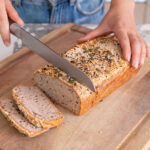
1-Ingredient Buckwheat Bread (Nourishing and GF)
My whole time favorite Gluten-Free Buckwheat Bread Recipe, and an absolute must-try! It's a simple, one-ingredient recipe that yields a nourishing, dense loaf. Perfect for those on a gluten-free diet or anyone seeking a gut-friendly bread alternative.
Servings
Ingredients
- 500 g raw hulled buckwheat kernels MUST be hulled, raw buckwheat groats for this recipe to work
- 210 ml water
- 1 ½ g sea salt flakes
- seeds optional - see notes
Instructions
- Soak the buckwheat: Rinse the hulled buckwheat kernels under cold water until the water runs clear, removing any dust or impurities. Transfer the rinsed buckwheat to a large bowl and cover with plenty of cold water, ensuring the kernels are fully submerged. Cover with a clean cloth and refrigerate for 6 to 7 hours. (see notes)
- Drain: Using a fine-mesh sieve, drain the soaked buckwheat briefly. Avoid over-draining (no need to let it sit in the sink for minutes). A little residual liquid (yes, it's a little slimy) is perfectly fine and will actually help with the texture.
- Blend: Transfer to a high-speed blender with 210 ml (¾ cup + 2 tbsp) water and the salt. Blend at low speed to get the blades moving, then slowly increase speed until you reach a very smooth texture with no buckwheat bits remaining. Add up to 2 tbsp of extra water if needed.
- Ferment: Pour the blended buckwheat batter back into the bowl. Cover and let it sit at room temperature for 12 to 24 hours (timing will vary depending on your climate; refer to the timing chart and tips above to double-check). Once fermented, you will notice the mixture should be slightly bubbly inside.
- Assemble: Prepare a 24 x 13 x 7 cm (9.5 x 5 x 2.75 inch) loaf pan and line with baking paper. Pour the fermented buckwheat batter into the prepared pan. If using, sprinkle the top with seeds. If you're in a cold climate, or feel your batter could use a little more fermentation, let it sit in the loaf pan for an extra hour near a source of warmth.
- Bake: When ready to bake, preheat your oven to 350°F (180°C) (347°F (175°C), fan on). Bake on the middle to upper rack for 90 minutes.
- Cool down: Remove the bread from the loaf pan and let it cool completely before slicing. This step is important for the best texture. Enjoy your homemade buckwheat bread!
Video
Notes
Seeds: You can use any seeds you like. My current favorite combo is pumpkin and sesame seeds, but flax, sunflower, or poppy seeds also work well. Just avoid chia seeds for this one. I usually add about 1 tablespoon.
Glass bowl: I recommend using a glass bowl, especially the first time you make it, so you can visualize the fermentation and bubbles as they develop. Any bowl will work, though, just avoid aluminum, iron, and copper, as they can hinder fermentation. Stainless steel is fine.
Soaking tips: If your kitchen is warm, I recommend soaking the buckwheat in the fridge, especially if you think it might sit a little longer than the recommended time (it happens to the best of us!). Over-soaking in a warm environment can cause an unpleasant smell to develop.
Fermentation tips: Follow the fermentation chart above to determine how long to ferment your bread. This is the most important step to get right. Most people get it right the first time, but there may be some trial and error, since every home environment is different and changes throughout the year, especially if this is your first time with fermentation. But trust me, it's well worth it! Under-fermenting will result in a hard, brick-like loaf, while over-fermenting will cause an unpleasant fishy smell.
Oven temperatures: This recipe was tested in a convection (fan-forced) oven, which circulates hot air so it bakes faster and more evenly. If you’re using a conventional (non-fan) oven, you can try increasing the temperature by about 35°F (20°C) and rotating the pan halfway through. Every oven behaves a little differently, so results may vary. Start checking a few minutes before the suggested time and trust your eye: it may need a little longer to become golden and cooked through.
Nutritional Information - Per Serving
Calories 115kcal | Carbohydrates 25g | Protein 4g | Fat 1g | Sodium 42mg | Potassium 107mg | Fiber 3g | Sugar 0.6g | Calcium 6mg | Iron 1mg